
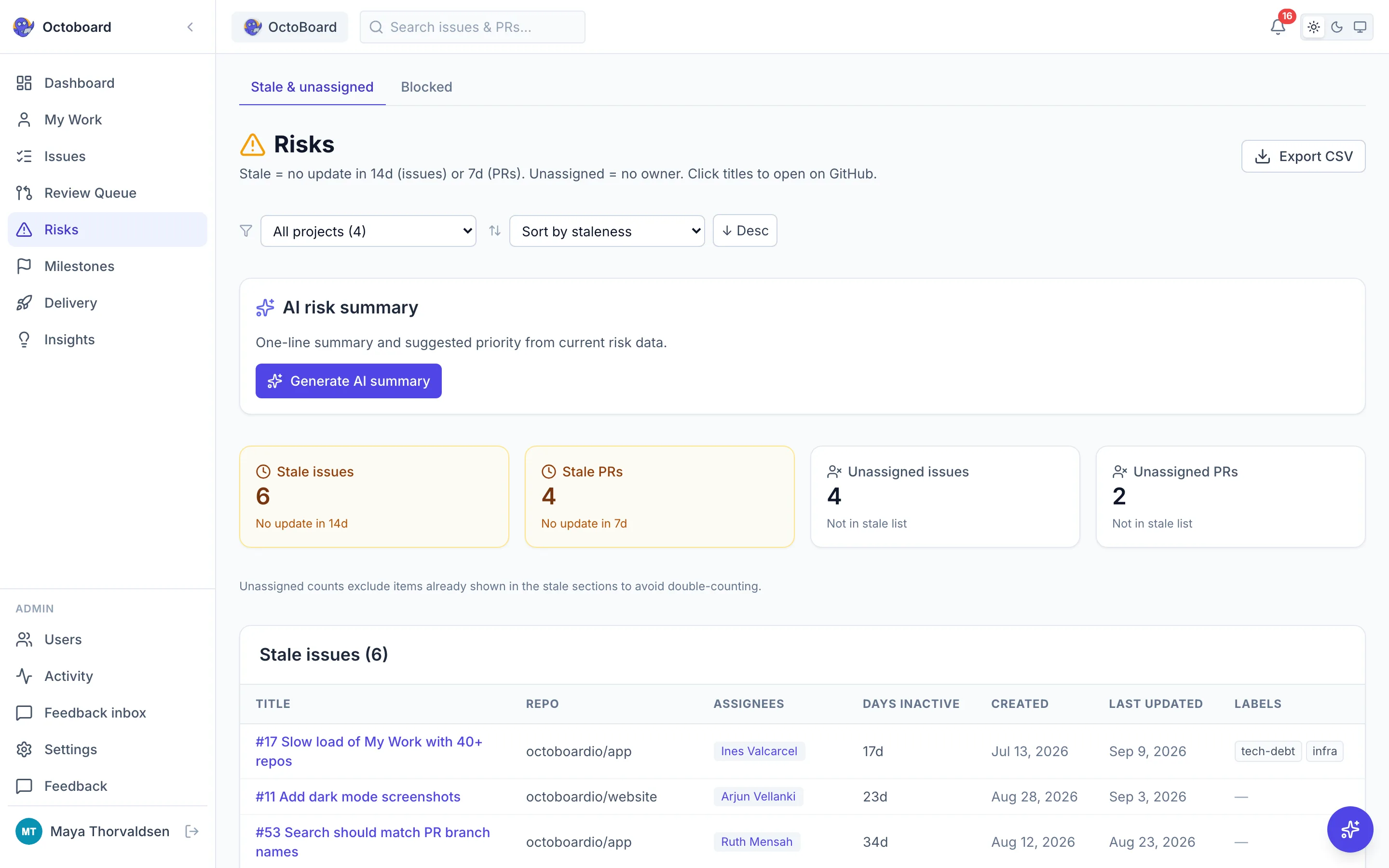
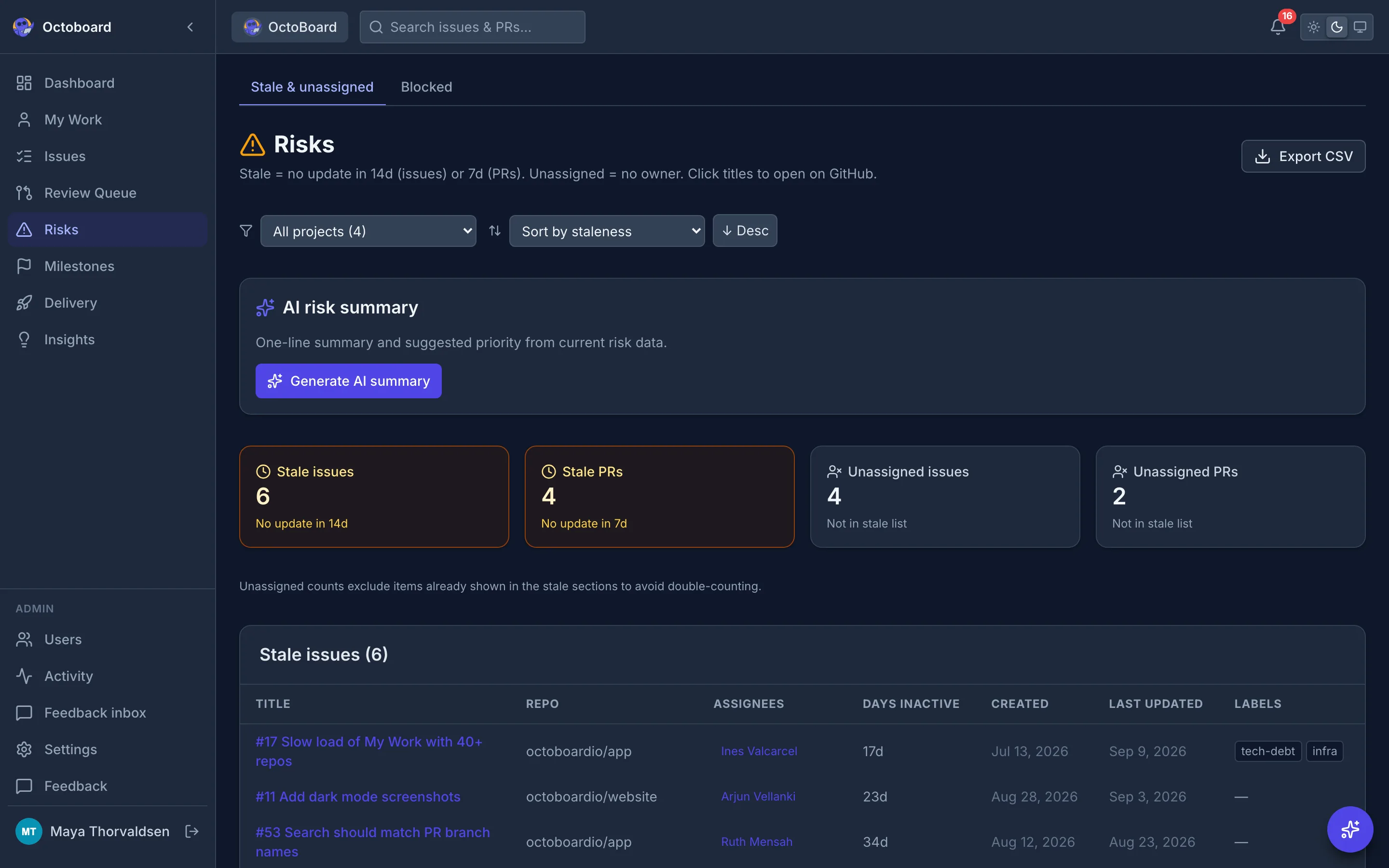
Risks
Catch problems before they escalate
Stale PRs (7+ days), stale issues (14+ days), and unassigned work are surfaced automatically, each with a direct link to GitHub.
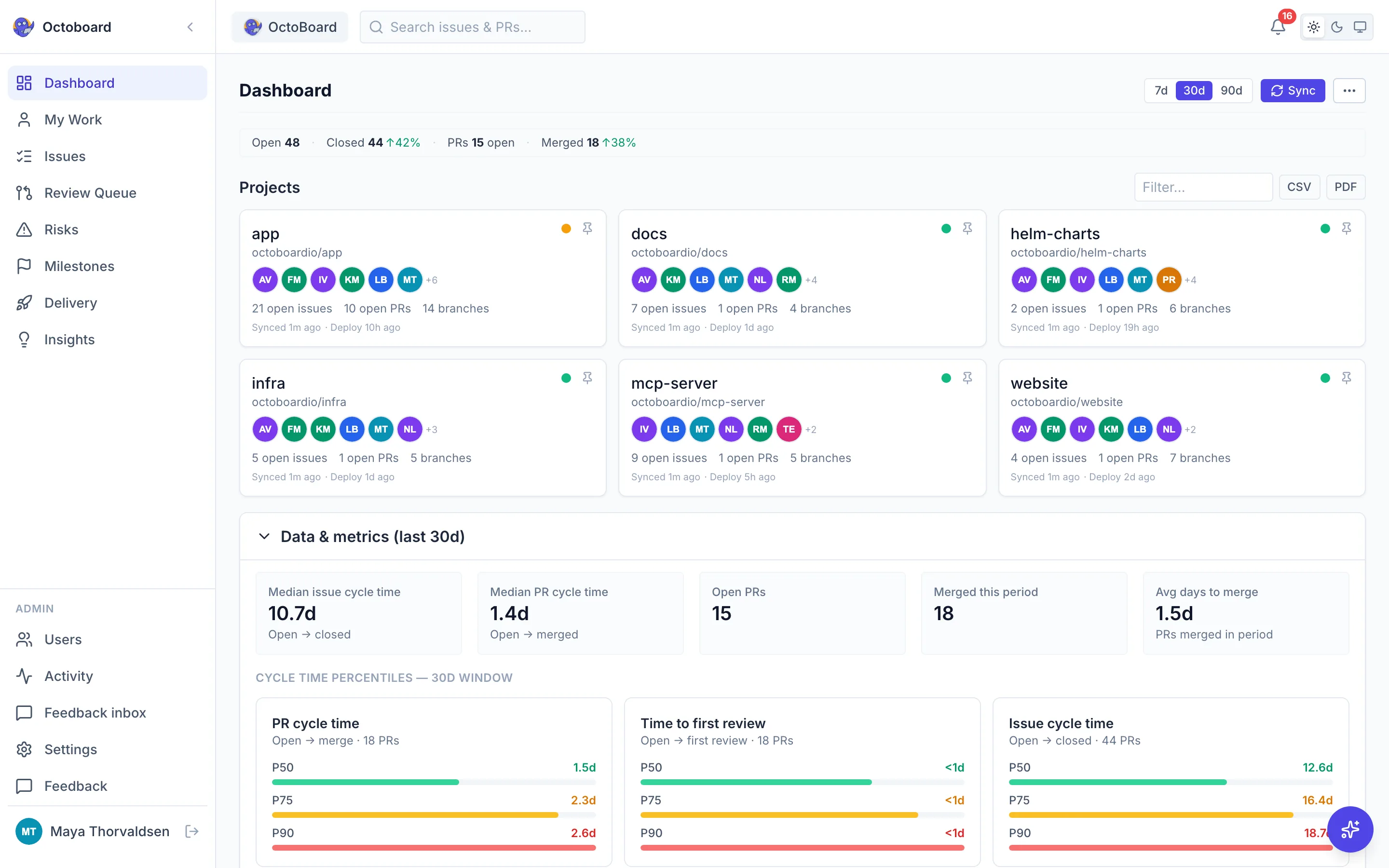
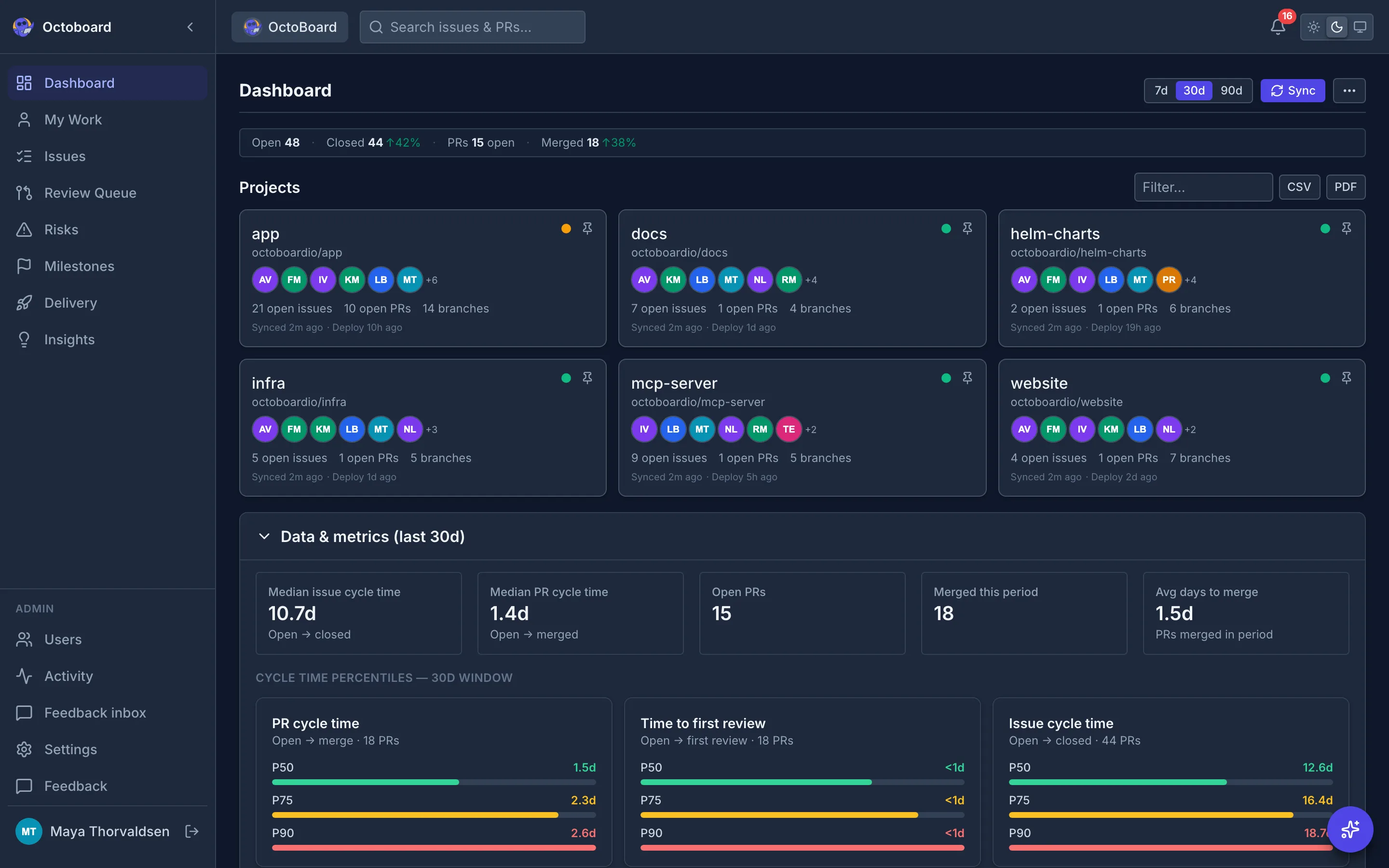
Octoboard reads your issues, pull requests, CI runs and deploys, shows what is stuck and at risk, and gives AI coding agents a work queue they can read over MCP.
Free for all teams. No per-seat pricing. Reads metadata only.
server app.octoboard.io/api/mcp
tool ready_for_agent
returns open issues that are unassigned, not blocked and not waiting on refinement, sized first
Built and used at
CloudDrove is Octoboard's first team and the company where Octoboard was built.
An agent reads the queue over MCP, opens a pull request in GitHub, and a person on your team reviews it. Octoboard keeps every step visible.
Octoboard reads GitHub and answers agents. It does not write to GitHub: the agent opens the pull request with its own access, and a person approves the merge.
These are the real screens from the app. Each one reads straight from your GitHub issues, pull requests, and Actions runs.
Risks
Stale PRs (7+ days), stale issues (14+ days), and unassigned work are surfaced automatically, each with a direct link to GitHub.
Review queue
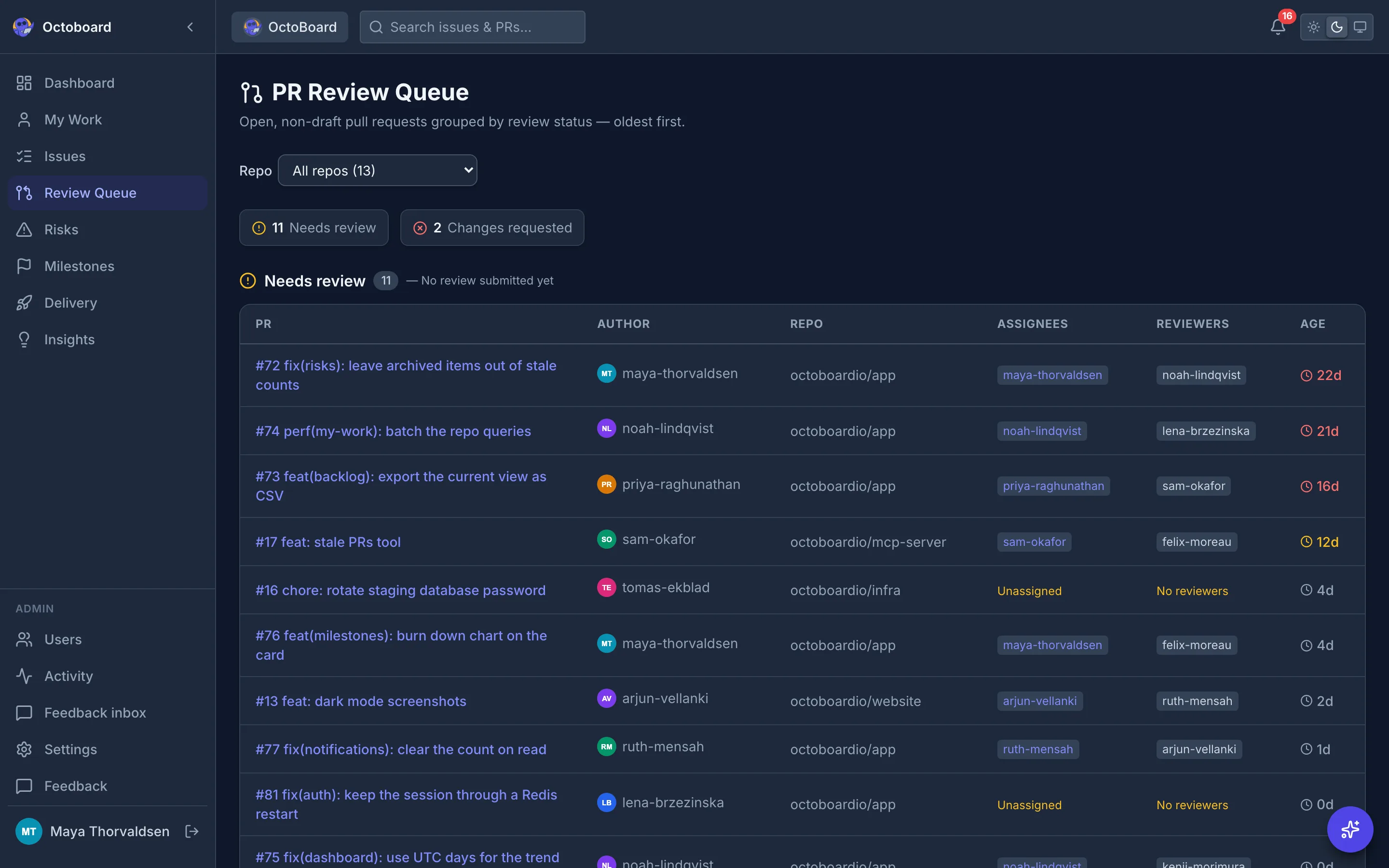
Open, non-draft pull requests grouped by review status, oldest first, next to a count of open review requests per reviewer. The Opened by filter separates people, AI agents, dependency bots and other automation.
How agent pull requests are grouped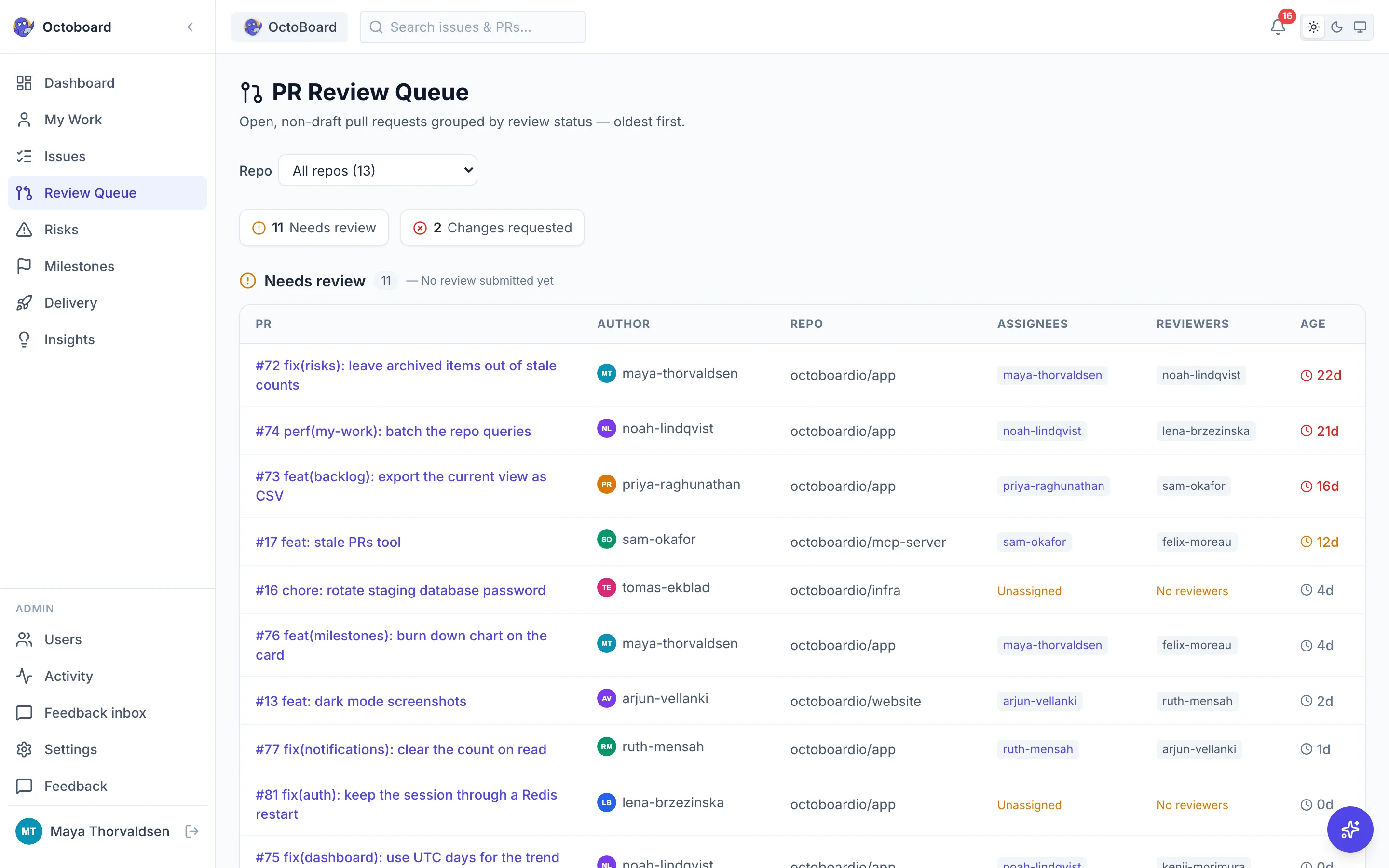
Delivery
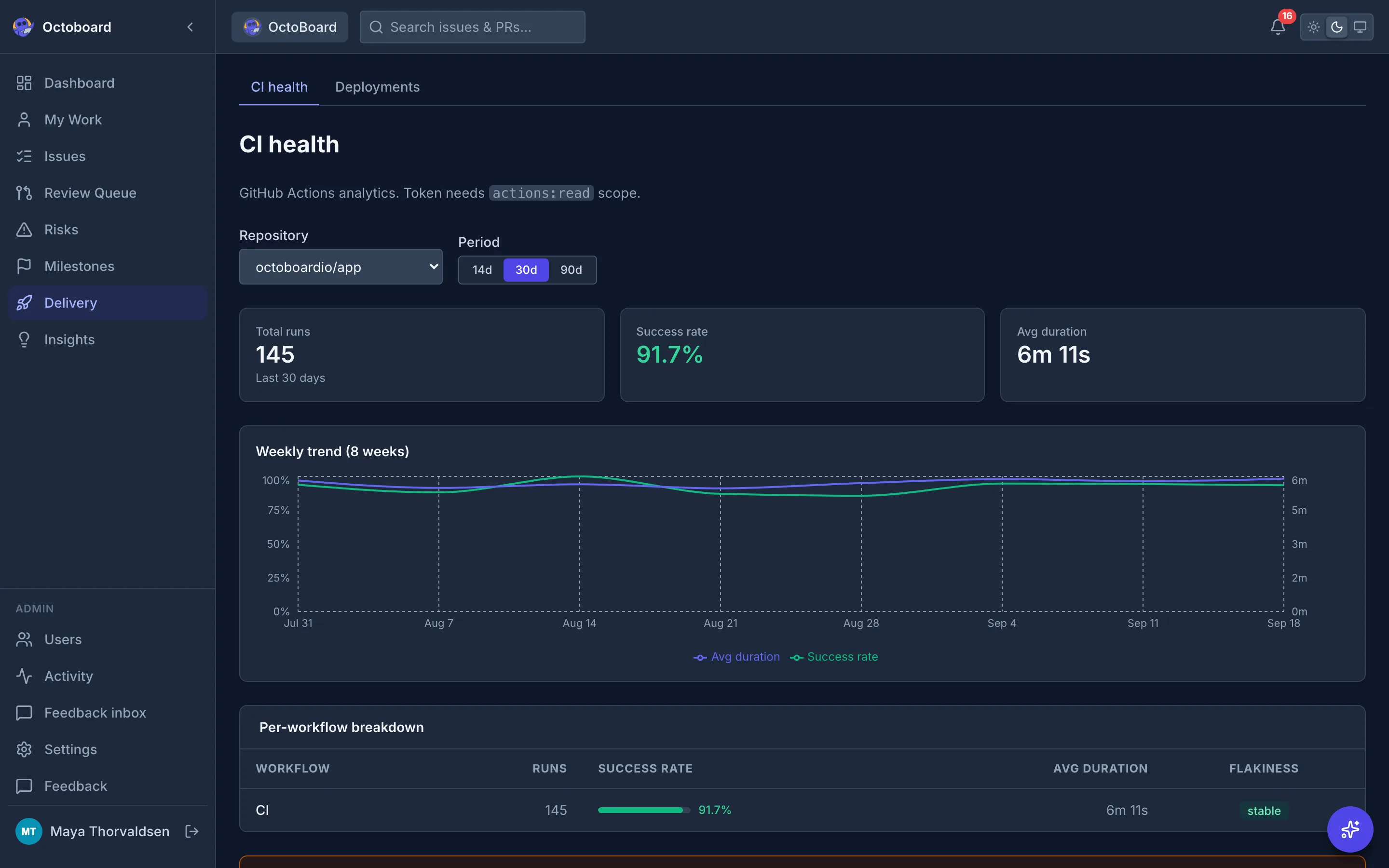
Deployment frequency, lead time, change failure rate, and MTTR, derived from your GitHub Actions runs and PR data. No extra tooling.
How each metric is calculated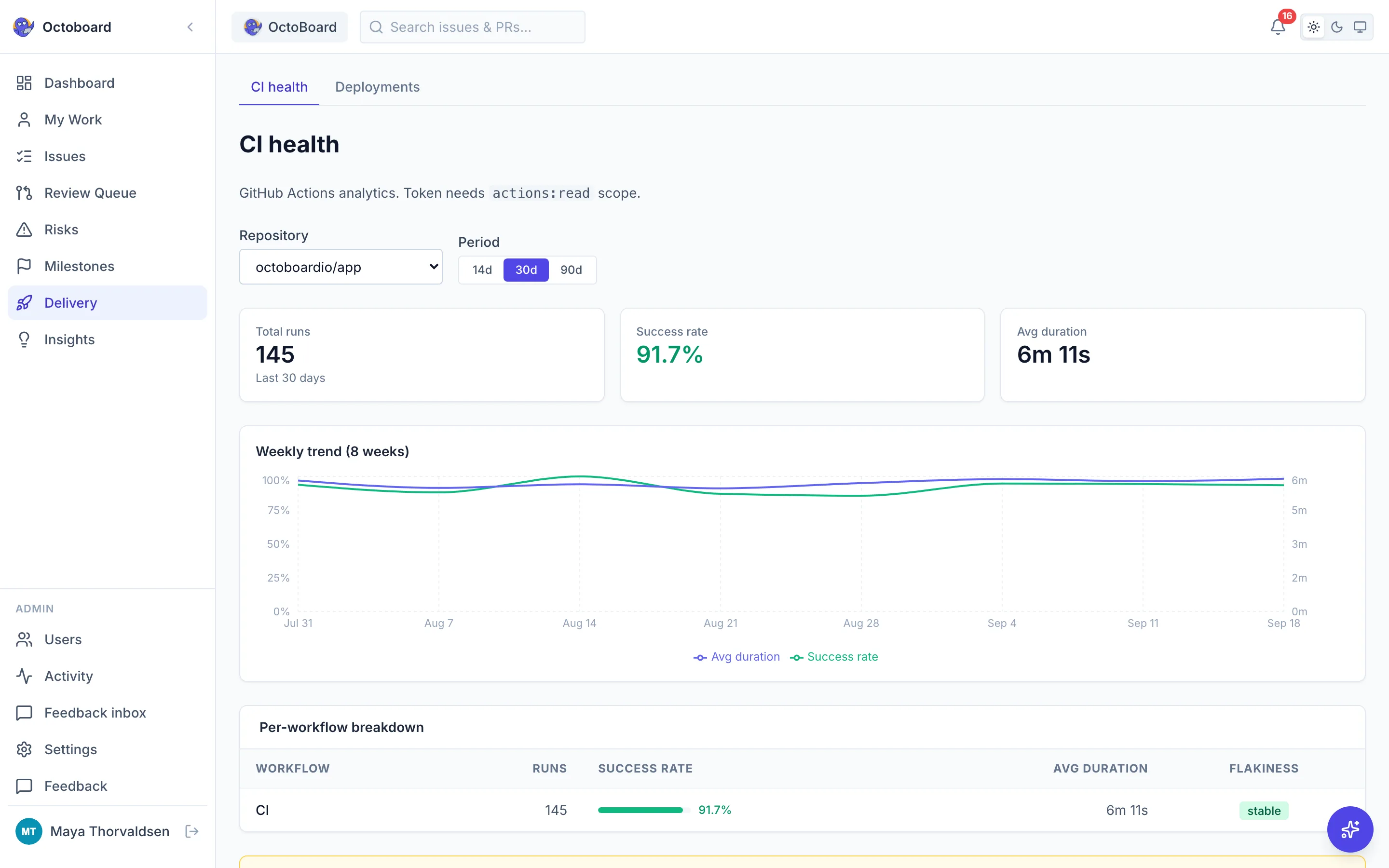
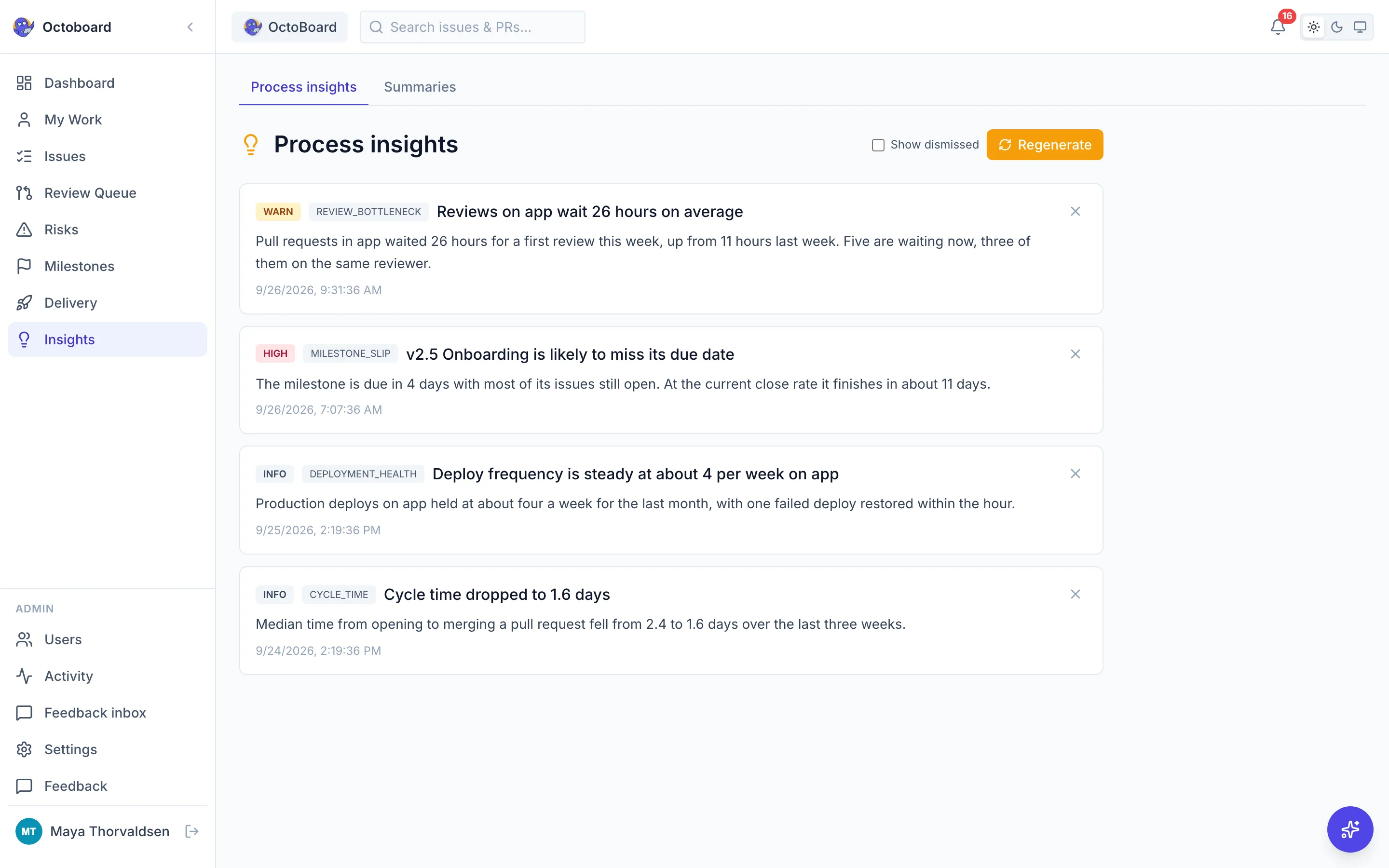
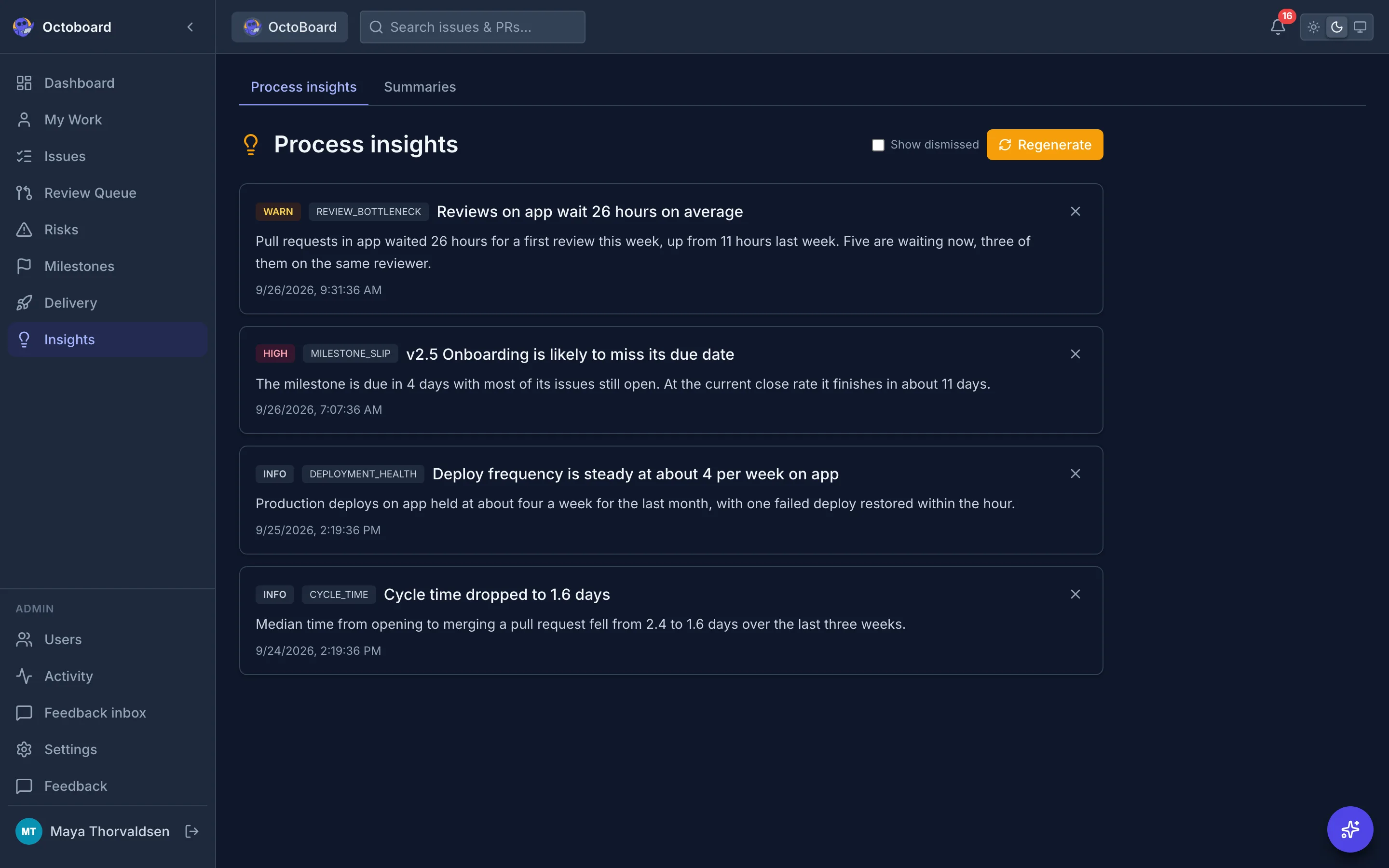
Insights
Written summaries of patterns in cycle time, throughput, and milestones. Included on the hosted app. Self-host and point it at Groq, OpenAI, Anthropic, or Ollama. Only ticket metadata is sent, never file contents or diffs.
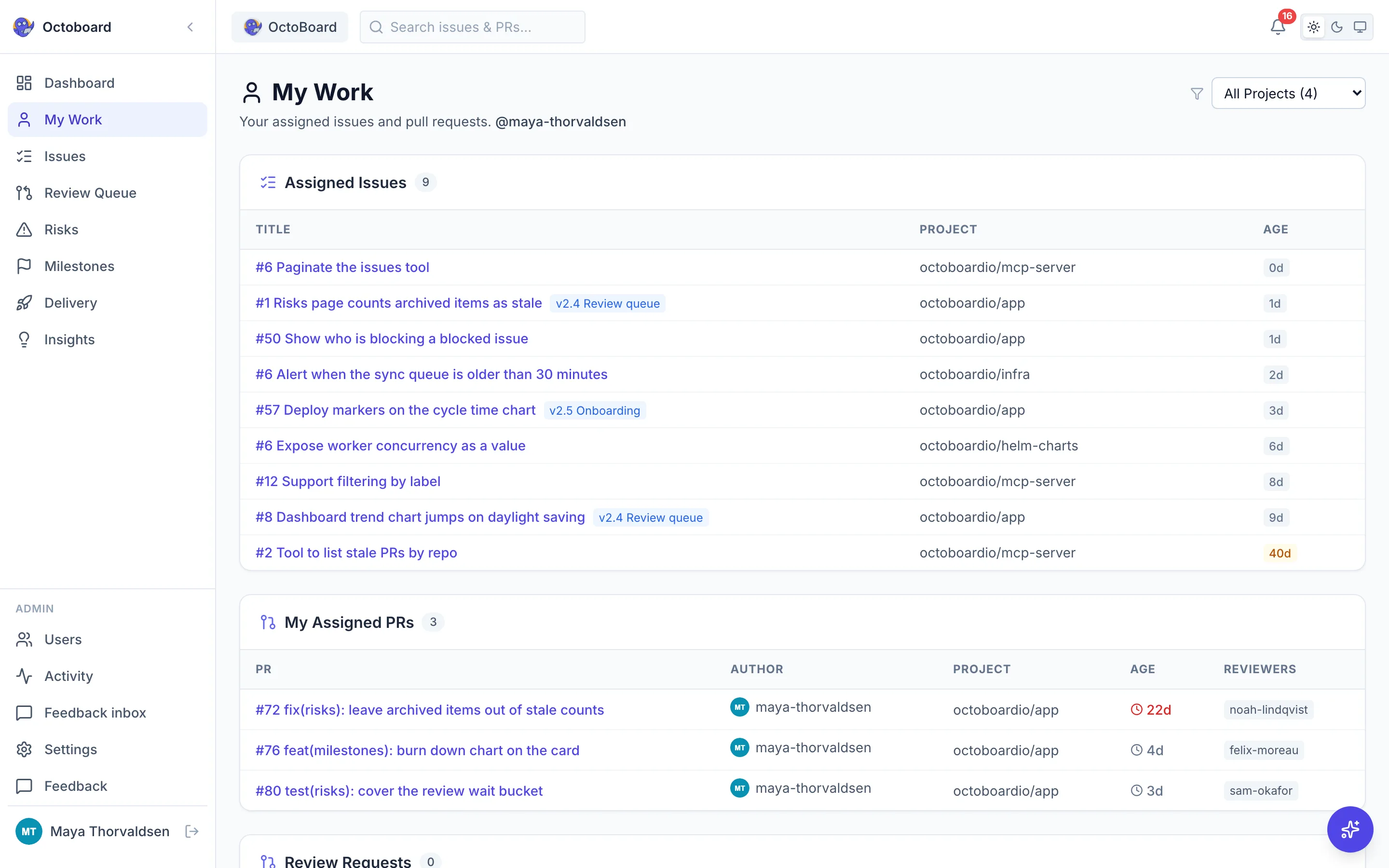
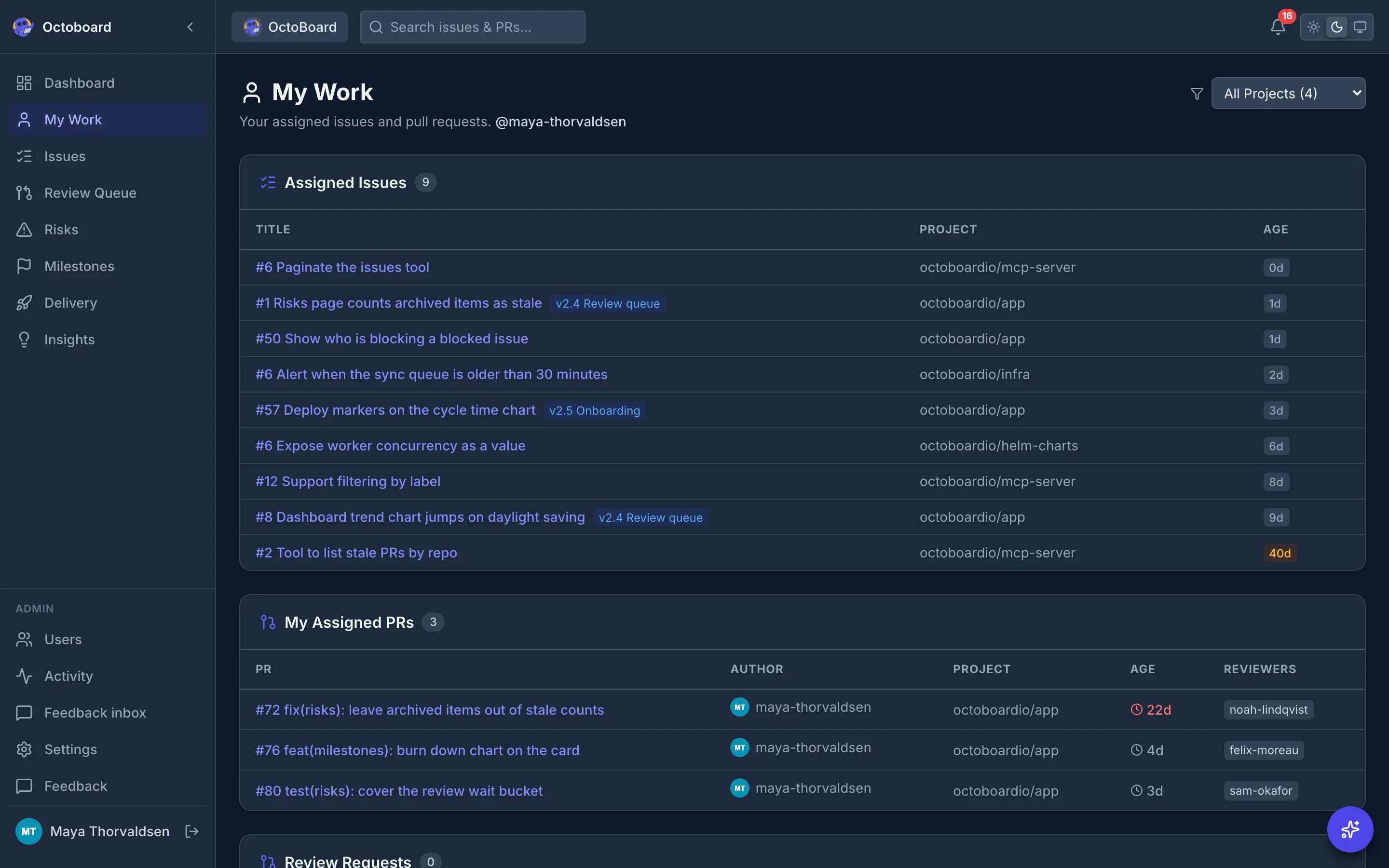
My Work
Issues assigned to you, your open pull requests, and the reviews teammates have requested from you, across every tracked repo.
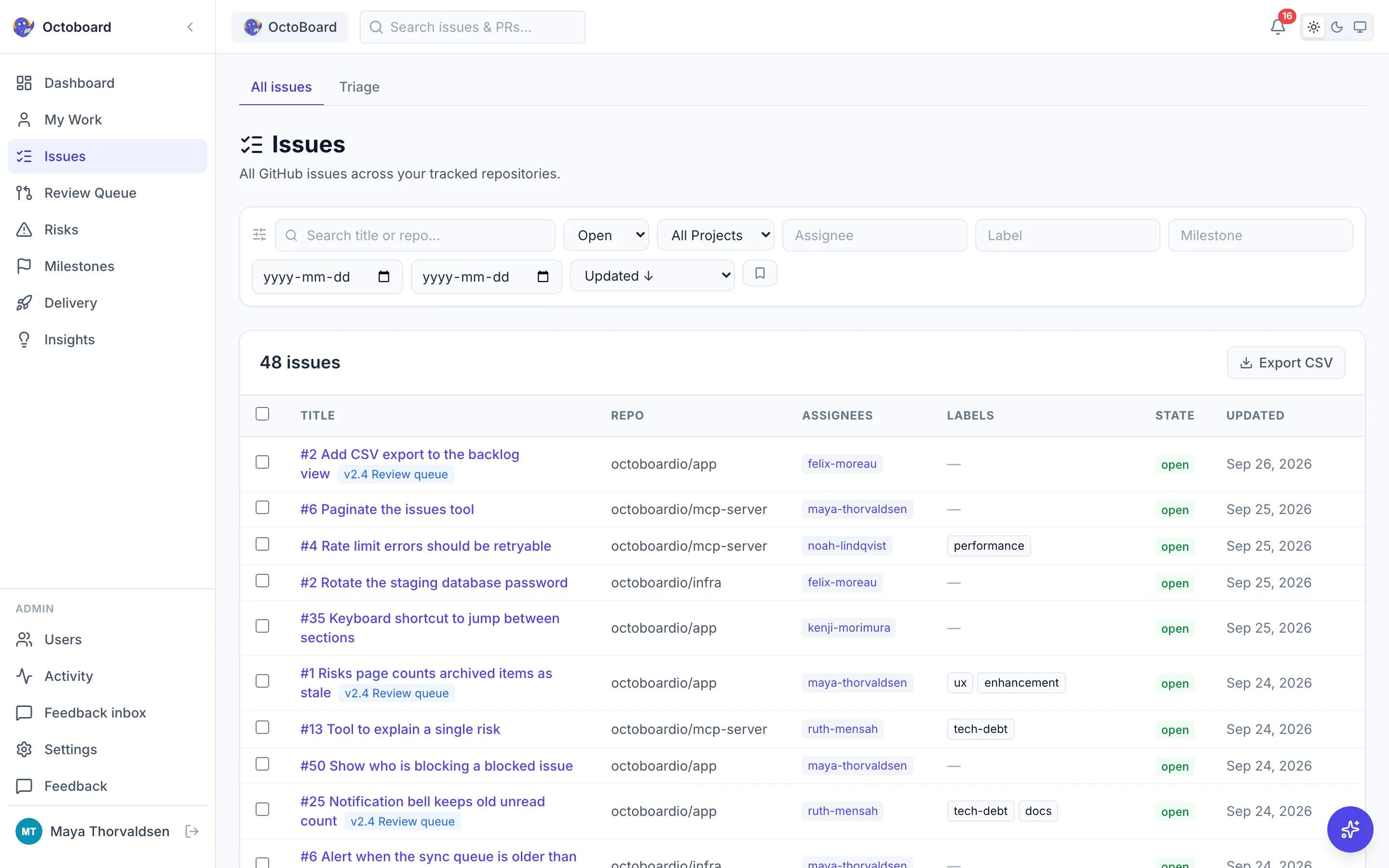
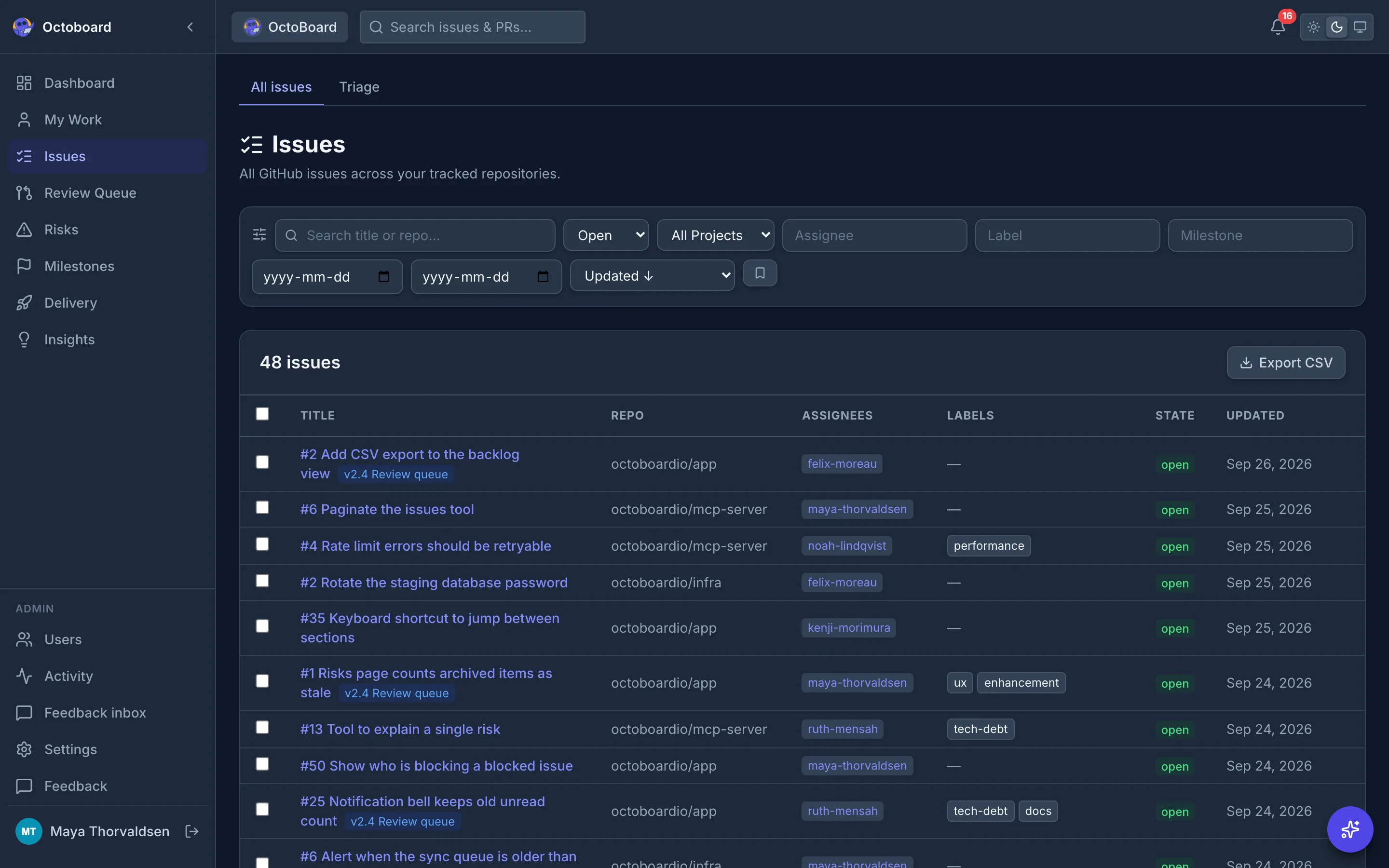
Issues
All GitHub issues across your tracked repositories, with filters you can save and reuse.
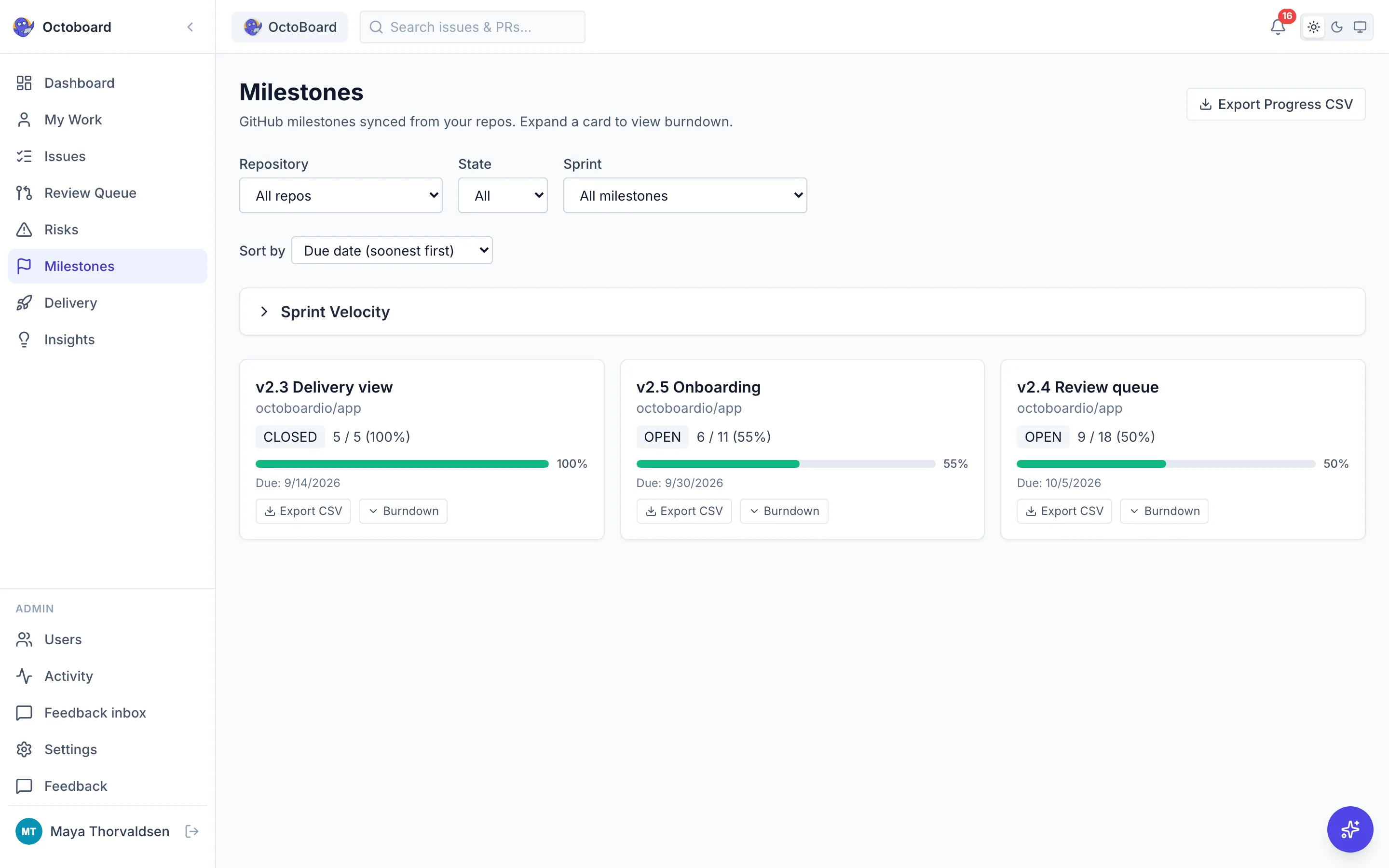
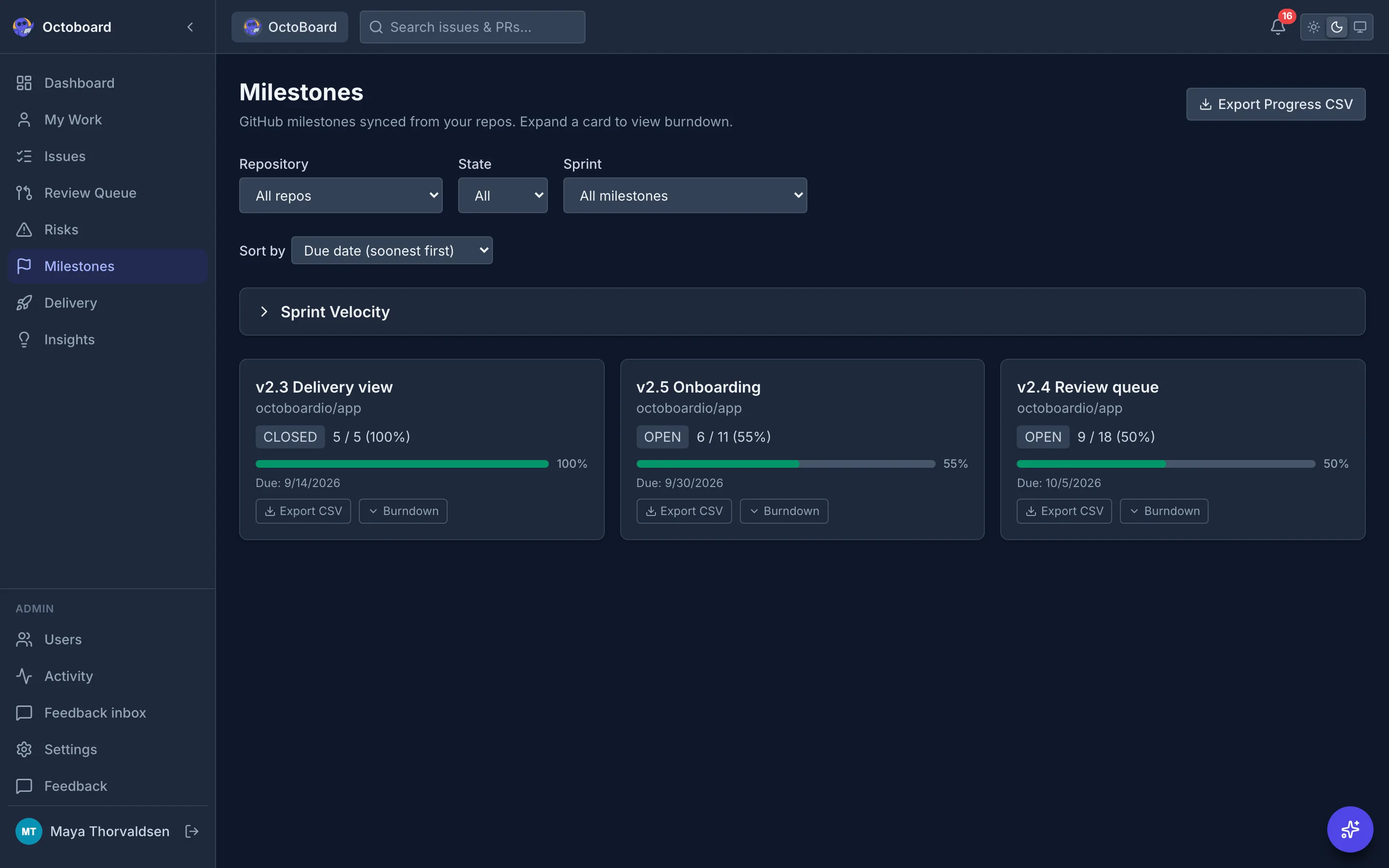
Milestones
GitHub milestones synced from your repos, with open and closed counts, due dates, and a burndown for each.
No second tracker to keep in sync. Issues, pull requests, Actions runs and milestones are the source, Octoboard is the view.
Open and closed issues and pull requests, throughput and project health across every tracked repo.
Stale pull requests, stale issues, unassigned and blocked work, each linked back to GitHub.
Pull requests waiting on review, oldest first, filtered by who opened them: people, AI agents, dependency bots or other automation.
CI health, workflow runs and the four DORA metrics from your Actions runs and pull request data.
Written findings about cycle time, throughput and milestones, and a plain language summary of current risks.
Progress, due dates and a burndown for each GitHub milestone.
Your assigned issues, your open pull requests and the reviews requested from you, in one list.
Connect your org, pick repos, invite your team, then check risks, the review queue and delivery.
11 read only tools, including ready_for_agent and agent_activity, for Claude Code and other MCP clients.
Your team already tracks work in GitHub Issues and PRs. Why pay $8/seat/month for Jira to get the same visibility? Octoboard reads what GitHub already knows.
Coding agents like Copilot, Claude and Codex now pick up GitHub issues and open pull requests. Octoboard shows that work next to your team's, so reviews do not quietly pile up.
claude mcp add --transport http octoboard \
  https://app.octoboard.io/api/mcp \
  --header "Authorization: Bearer YOUR_API_KEY"
11 read only tools
One-click OAuth. No passwords, no tokens, no config files.
Install the GitHub App on your org and choose the repositories to track. Sync starts right away.
Delivery throughput, review health, and risk signals, as soon as the first sync lands.
Optional. Create an API key and add the MCP server to Claude Code or any MCP client.
Case study
CloudDrove manages 60+ repos (public and internal) with a team of 30+ engineers. Before Octoboard, they used Jira for project tracking, which meant duplicating every GitHub issue, syncing statuses manually, and paying per seat.
After switching to Octoboard, the team dropped Jira entirely. GitHub Issues became the single source of truth. Delivery metrics, risk signals, and team performance are now visible as GitHub events arrive, with no manual effort and no cost.
Read the case studyYes. Octoboard is free for all teams, with no per-seat pricing and no credit card required. We may apply reasonable capacity limits, such as on connected repositories, to keep the service available for everyone.
Only metadata: issue titles, PR states, workflow statuses, and contributor activity. We never access your source code, file contents, or commit diffs.
Yes. Octoboard runs an MCP server with 11 read only tools, including ready_for_agent, which lists open issues an agent could pick up next. Agents only see repositories the owner of the API key can access.
GitHub Projects gives you boards. Octoboard gives you the analytics layer on top: DORA metrics, cycle time, throughput charts, risk detection, AI-powered insights, and a team leaderboard. Think of it as the dashboard GitHub doesn't have.
Octoboard uses GitHub App installation tokens, so each org gets its own rate limit budget rather than sharing one with other users. Syncs are metadata only and stay well inside that budget for most teams.
Octoboard supports GitHub.com today. GitHub Enterprise Cloud and GitHub Enterprise Server are not supported yet.
About 5 minutes. Sign in with GitHub, install the GitHub App on your org, and your dashboard is live. No migration, no configuration, no training needed.
Free for all teams. No credit card. No per-seat fees.